
How does healthy vision work?
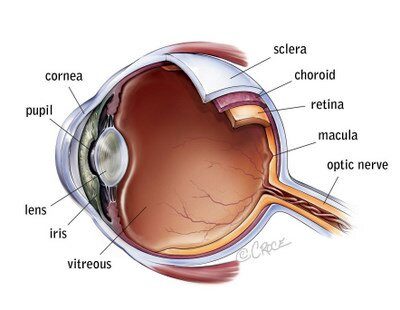
In a healthy human eye, reflected light is focused through the cornea, pupil, crystalline lens and vitreous humour, onto the retina, which converts the light into electrical impulses, and sends them along the optic nerve to the brain, where they are decoded by the visual cortex into sight.
The area at the centre of the retina is the macula, where fine visual detail is captured, at the centre of which lies an area, smaller again, called the fovea, which captures the very finest visual detail.
If any of the eye’s light-collection, capture and processing components are damaged or missing, through injury or illness, vision is impaired.
What is retinitis pigmentosa?
Retinitis pigmentosa refers to inherited eye disorders involving gradual damage to and loss of photoreceptor cells in the retina. This causes a gradual degeneration of sight, particularly of peripheral vision, often resulting in tunnel vision.
Damaged photoreceptor cells (the rods and cones) leave the retina unable to process and transmit visual information. With a prevalence of one in 5000 people and affecting 1.5 million people worldwide, retinitis pigmentosa is the predominant cause of inherited blindness.
What is age-related macular degeneration (AMD)?
AMD is a condition whereby the photoreceptor cells in the retina gradually degenerate and die, thereby losing the ability to convert light into electro-chemical signals. Consequently, nerve signals are no longer transmitted through the optic nerve to the brain.
AMD severely compromises central vision, crucial for tasks such as reading and facial recognition. Usually affecting people over 65, AMD is the root cause of nearly half the cases of legal blindness in Australia.
Who could use a bionic eye?
The bionic eye requires patients to have a developed visual cortex, intact optical nerve, and some intact retinal cells. To benefit from this technology, patients will have had to see in the past.
Bionic Vision Australia is developing retinal prostheses for patients with advanced stages of retinitis pigmentosa and age-related macular degeneration.